SMS Authentication for User Verification, OTP, and 2FA: How It Works

Blog
SMS authentication is the process of verifying a user's identity by sending a one-time code to their mobile number. It underpins SMS one-time password (OTP) flows, two-factor authentication (2FA), and broader multi-factor authentication (MFA) strategies across industries.
This guide covers how SMS authentication works technically, how it integrates via API, which industries rely on it most, and where it falls short—along with a clear comparison with alternative channels.
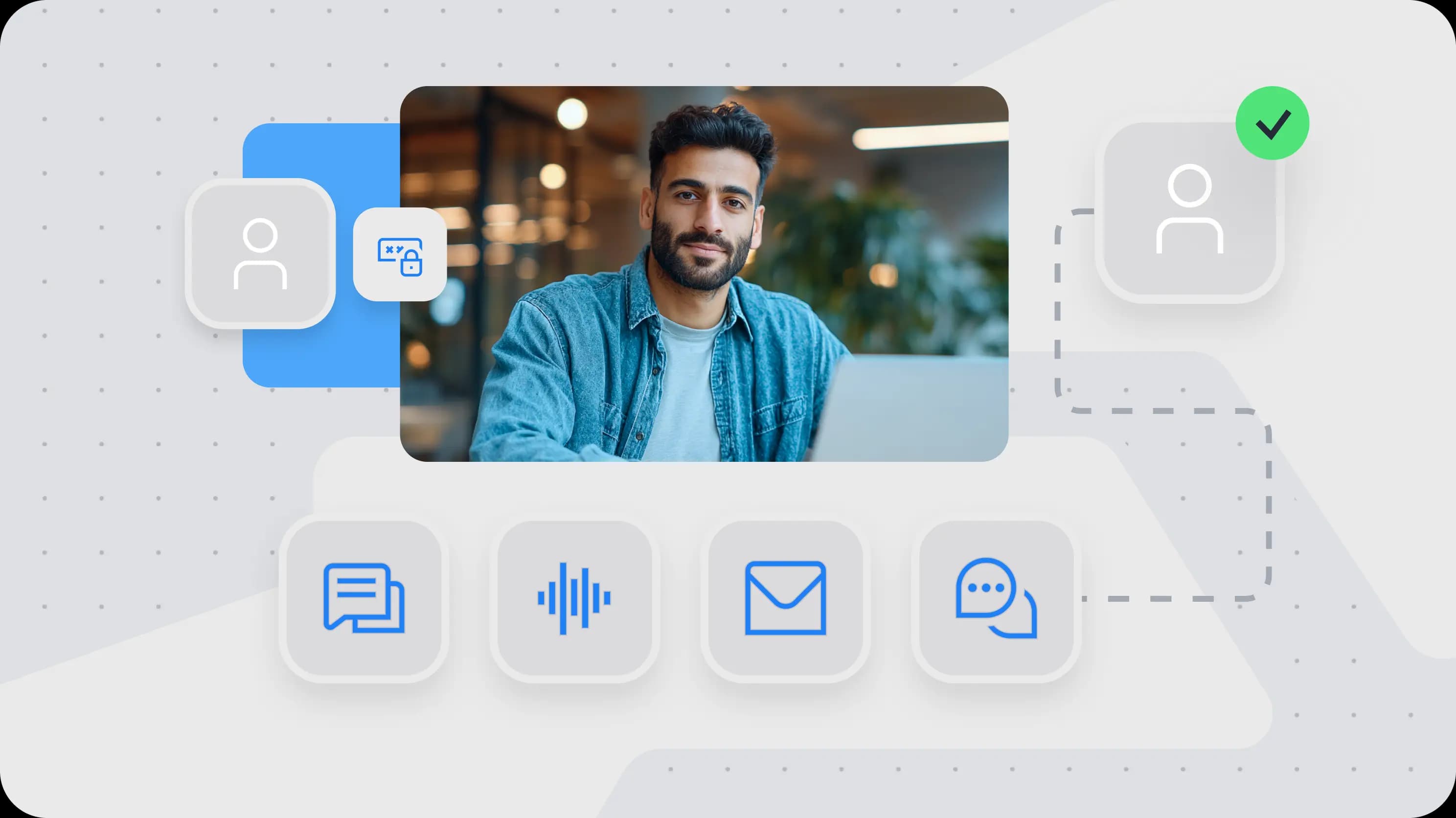
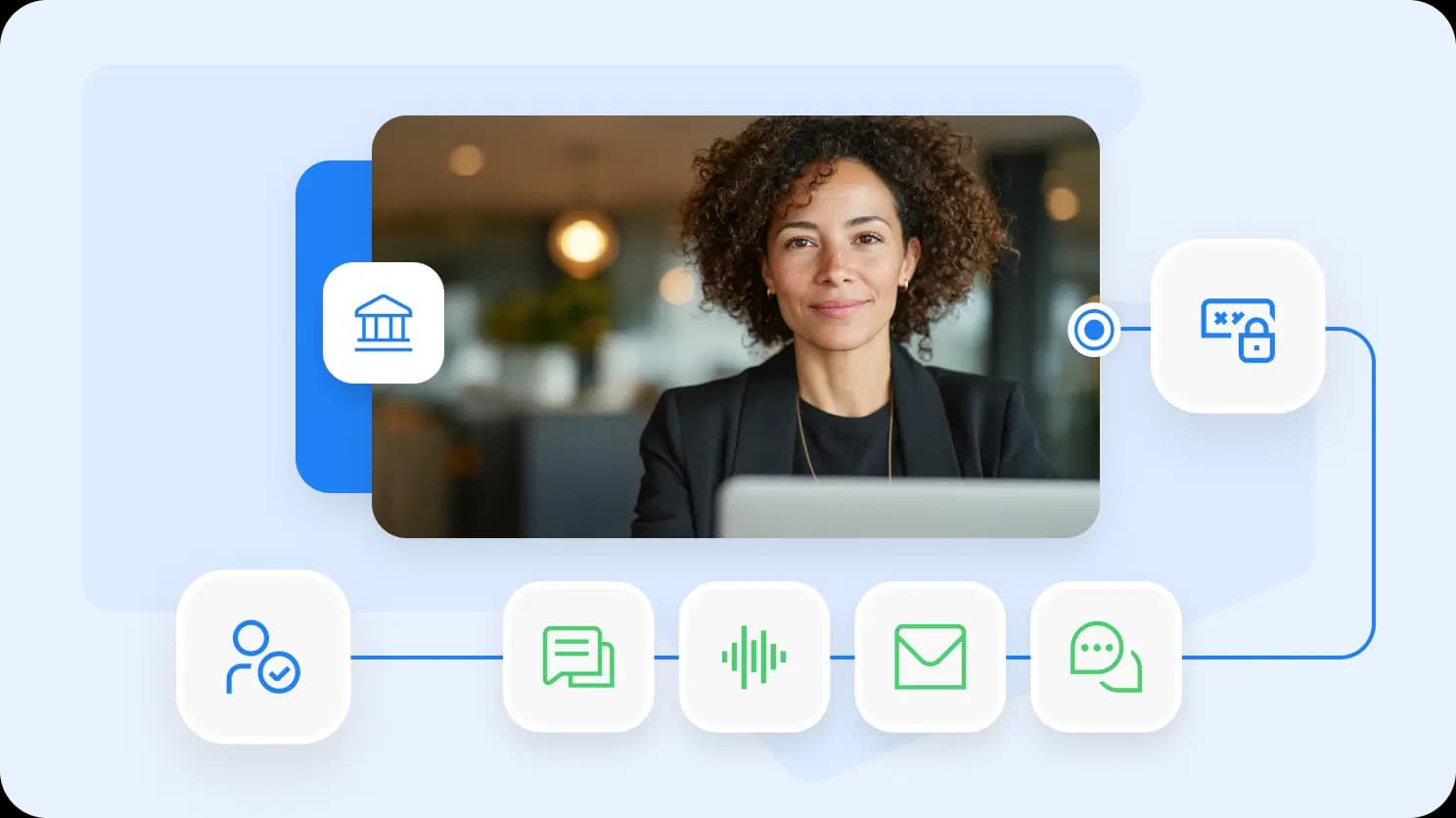
LANCK Platform delivers OTPs and verification messages via SMS, voice, WhatsApp, Telegram, RCS, and email—combining AI fraud detection and cascade scenarios to maintain high delivery rates across every market.
Introduction to SMS Authentication and User Verification
Every time you log into a banking app and receive a six-digit code on your phone, you’re using SMS authentication. It remains one of the most widely deployed user verification methods globally—not because it's perfect, but because it's universally accessible. Anyone with a mobile number can use it without installing additional apps or learning a new workflow.
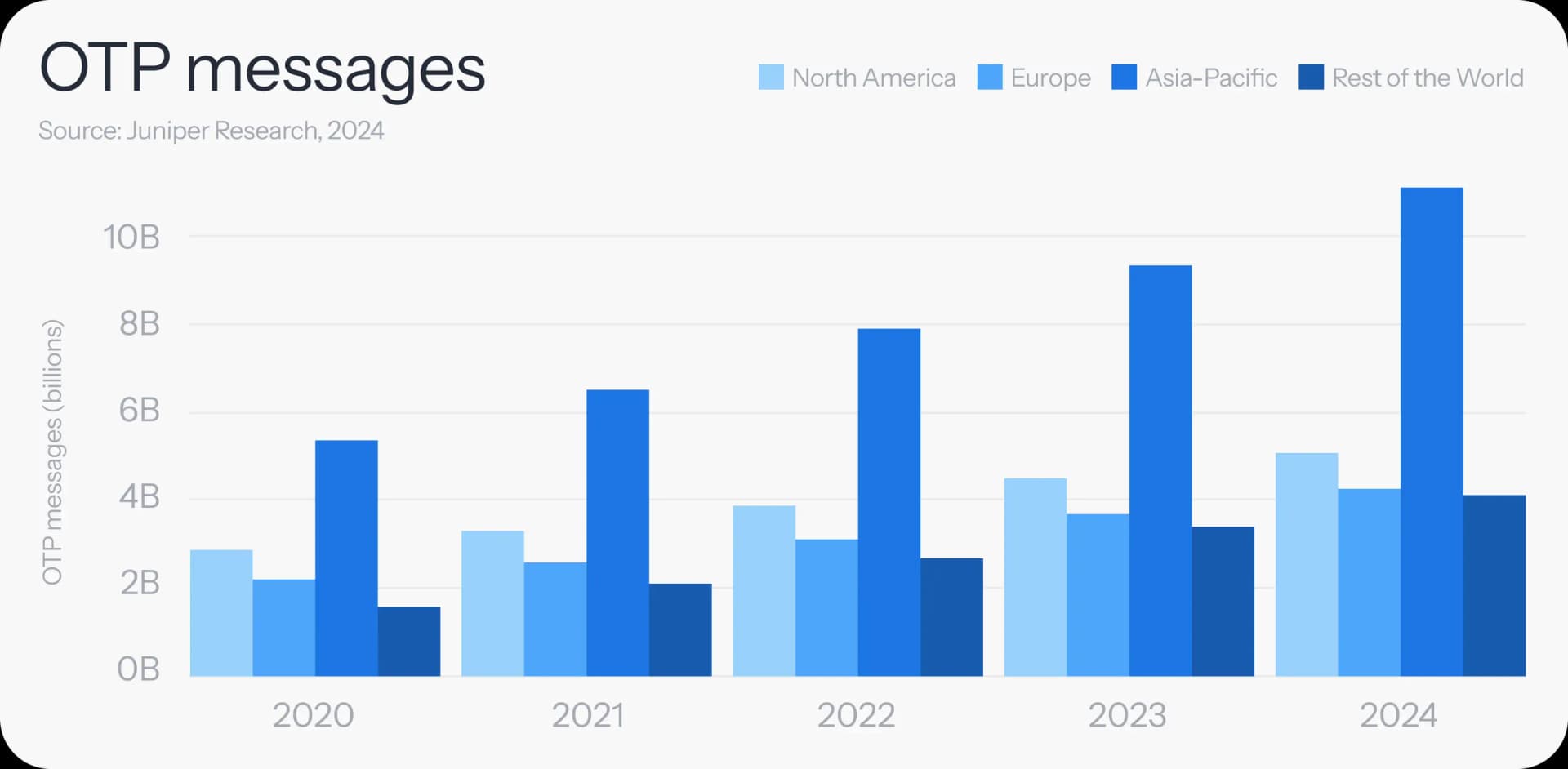
The scale is significant. According to Juniper Research, mobile operators generated $22.3 billion in SMS OTP revenue globally in 2024 alone—a figure that reflects how deeply OTP delivery is embedded in digital services worldwide.
For product teams, developers, and security leaders, understanding how SMS authentication works—and where its limitations lie—is essential for building user-facing digital systems.
What Is SMS Authentication and How It Works to Verify Users
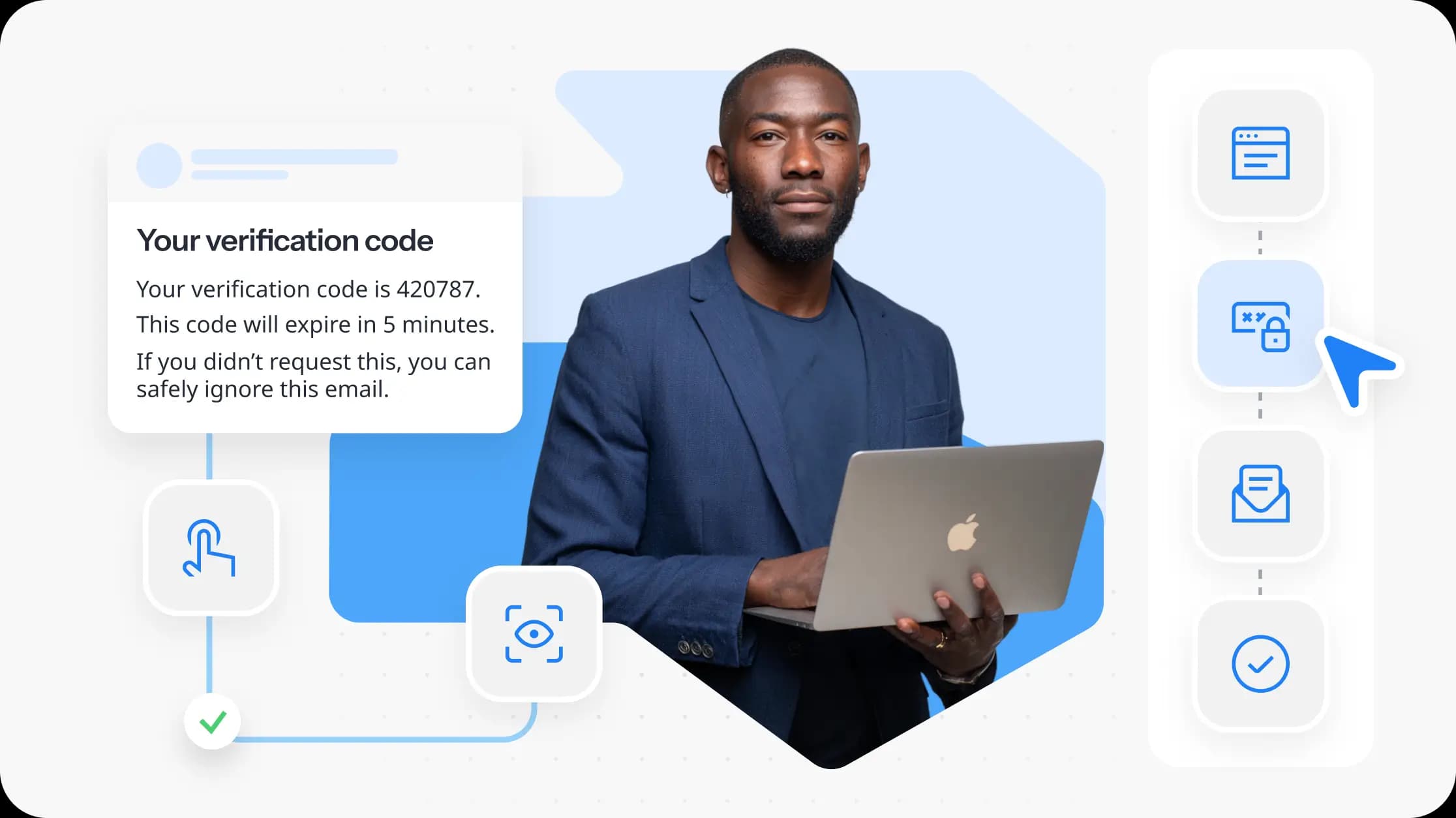
SMS authentication verifies a user's identity by sending a time-limited code to a phone number they control. It is based on device possession—the assumption that the person receiving the SMS is the legitimate owner of that phone number. That ownership also acts as a second verification layer on top of something the user knows, such as a password, forming the foundation of 2FA and MFA flows.
The Technical Flow Behind SMS Authentication
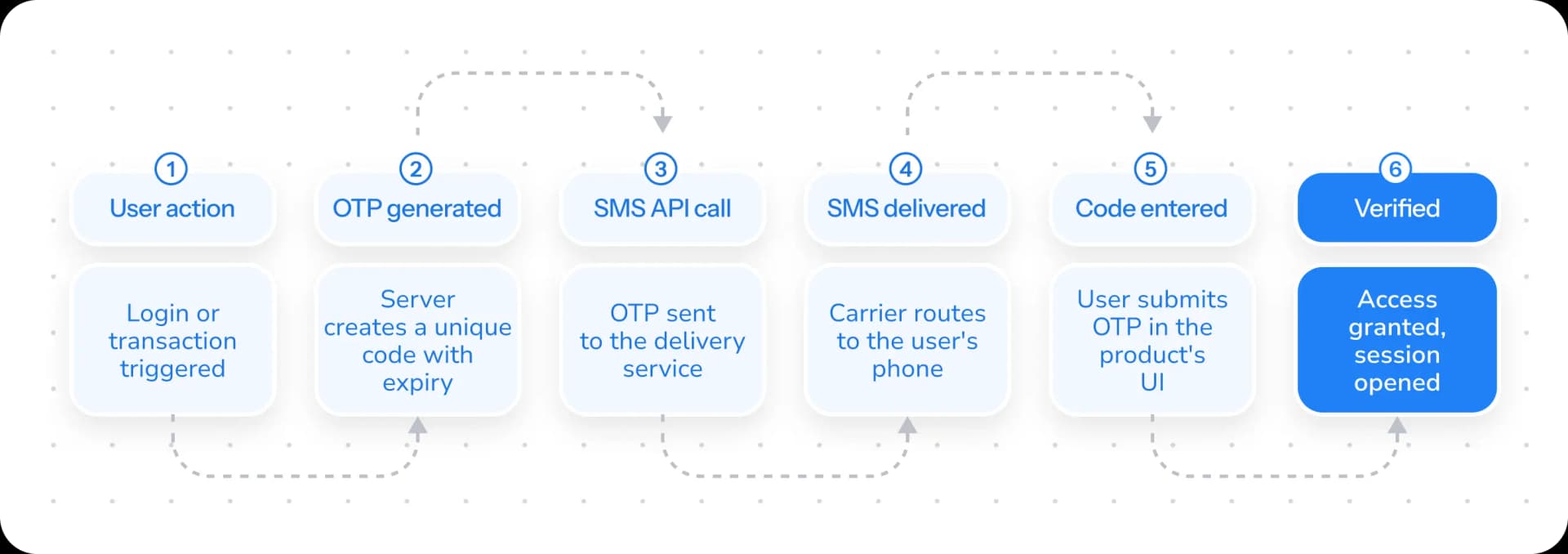
When a user triggers an SMS authentication event—login, registration, or transaction—the following sequence takes place:
- A digital service's backend generates a one-time code (typically a 4–8 digit numeric string) using a cryptographically secure process.
- This code is stored server-side with an expiry window (commonly between 60 seconds and 10 minutes, depending on the use case).
- The digital service sends the code to the user's registered phone number via an SMS API or OTP delivery service.
- The message is routed through mobile operator networks to the recipient's device.
- The user enters the code in the application interface.
- The system validates the code (correct, unused, and within expiry).
If all conditions are met, access is granted.
The entire exchange typically completes in under 30 seconds. For most consumer applications, the delivery latency is under 10 seconds on well-configured routes—one of the key reasons SMS authentication remains dominant despite the availability of newer alternatives.
SMS OTP Explained
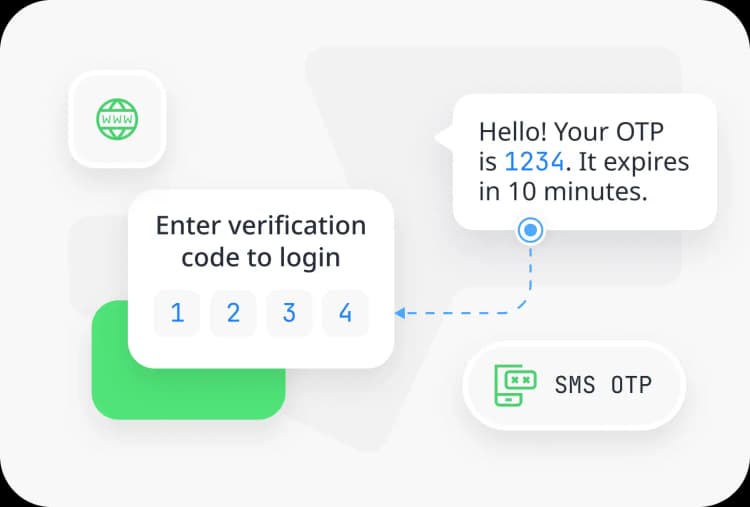
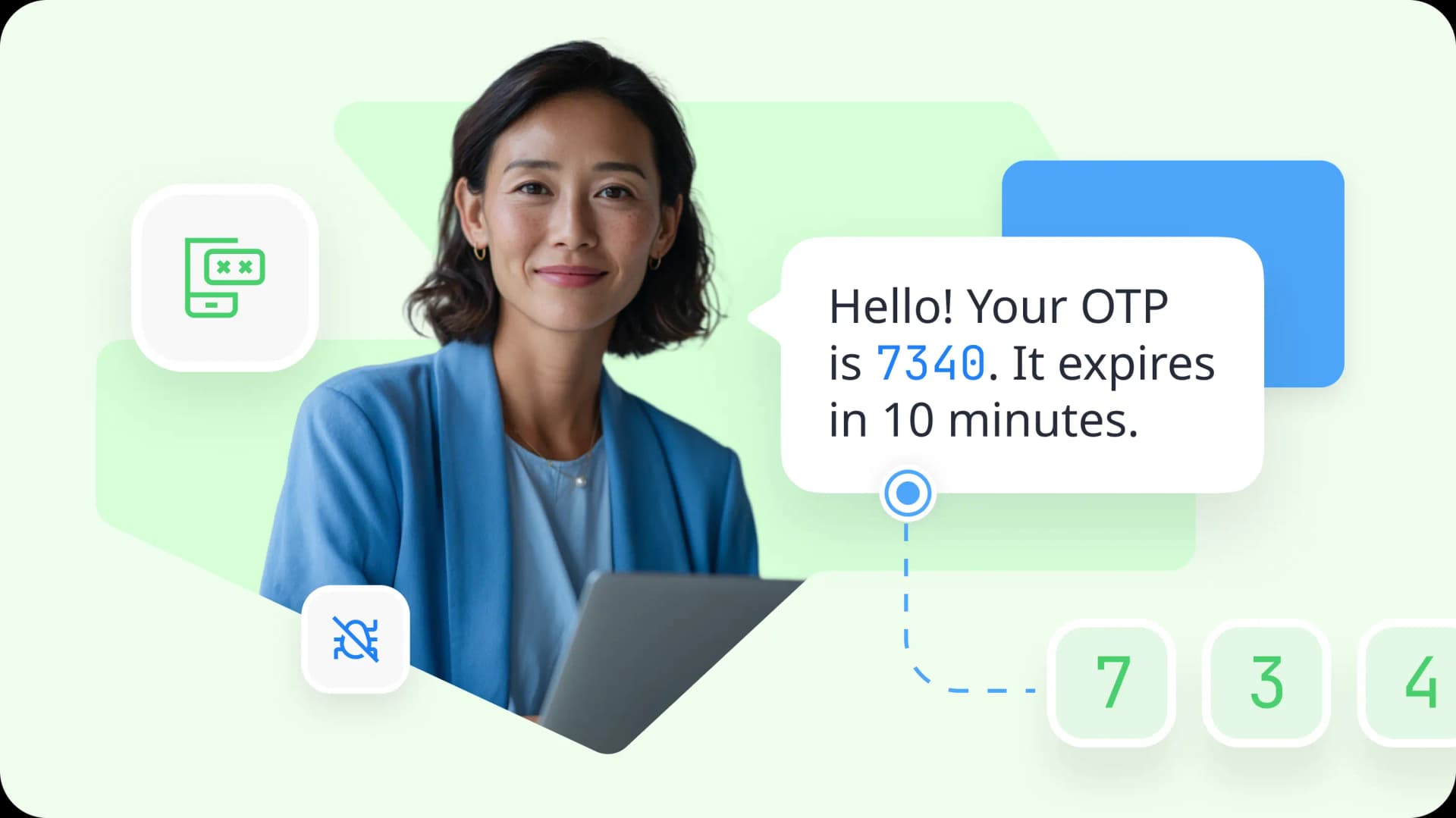
OTP stands for one-time password—a code valid for a single authentication event. Once used or expired, it becomes invalid. This "one-time" property is central to its security value: even if intercepted, the code can only be used once and within a limited time frame.
How OTP via SMS Differs from Static Passwords
Static passwords remain valid until changed, which makes them vulnerable if stolen. A one-time password eliminates that problem by design. Every SMS OTP is unique to the session that triggered it, generated fresh on demand, and invalidated immediately upon use or expiry.
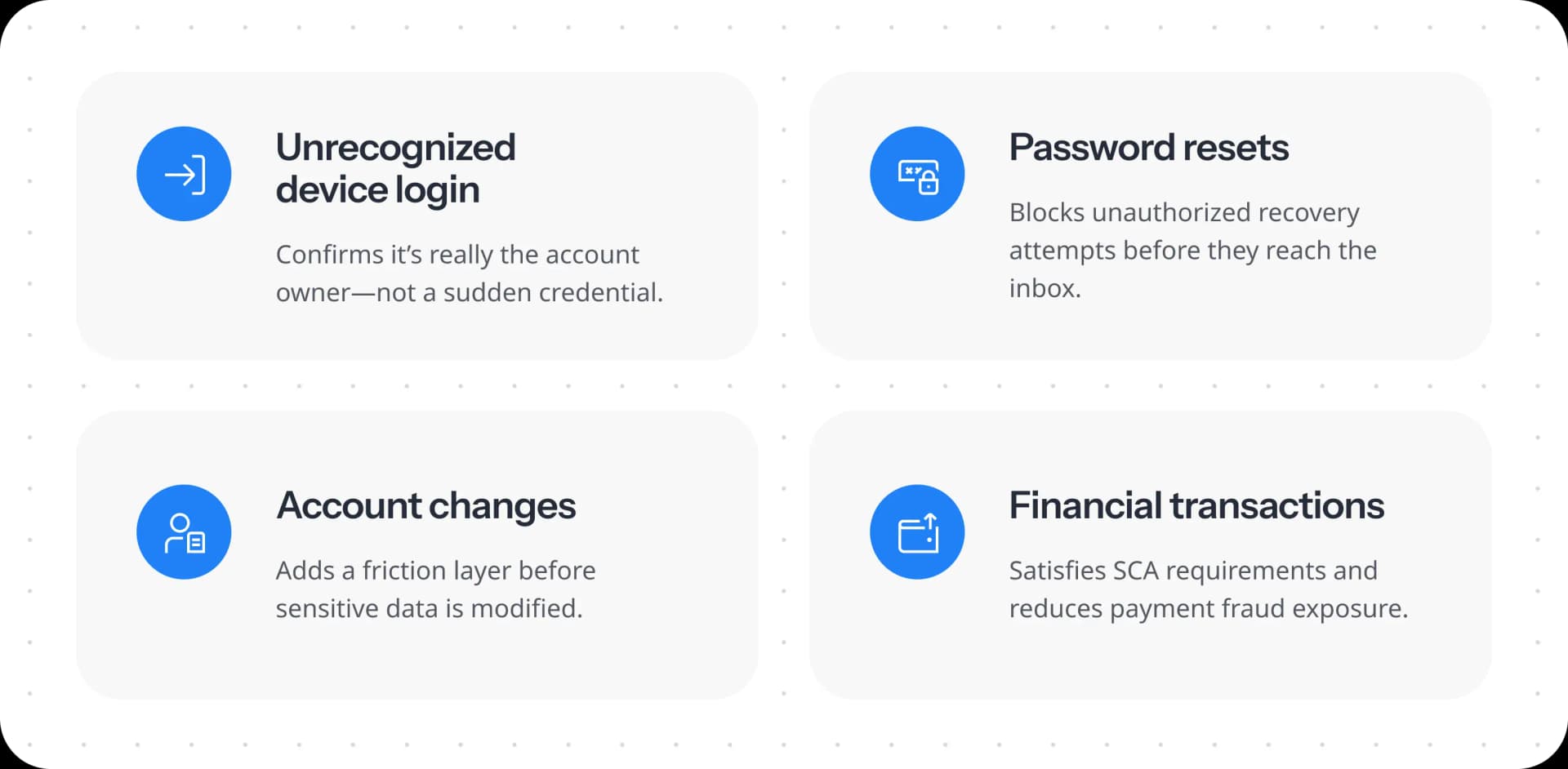
This makes SMS OTP authentication particularly well-suited for high-stakes moments in the user journey, such as:
OTP Formats and Code Length
Most SMS OTP implementations by default use a 6-digit numeric code—short enough to type quickly, and long enough to provide meaningful entropy against repeated attempts to gain access until the correct code is found. Each digit adds a factor of 10 to the possible combinations, so a 6-digit code has 1,000,000 possible values. With rate limiting applied to the entry form, that space is practically impossible to brute-force within a short expiry window. Some digital services use alphanumeric codes or longer numeric strings for higher-security contexts. Others include the application name and a brief call-to-action in the message body to reduce phishing confusion—for example: "Your [App Name] code is 482917. Do not share this with anyone."
SMS 2FA and Multi-Factor Authentication (MFA)
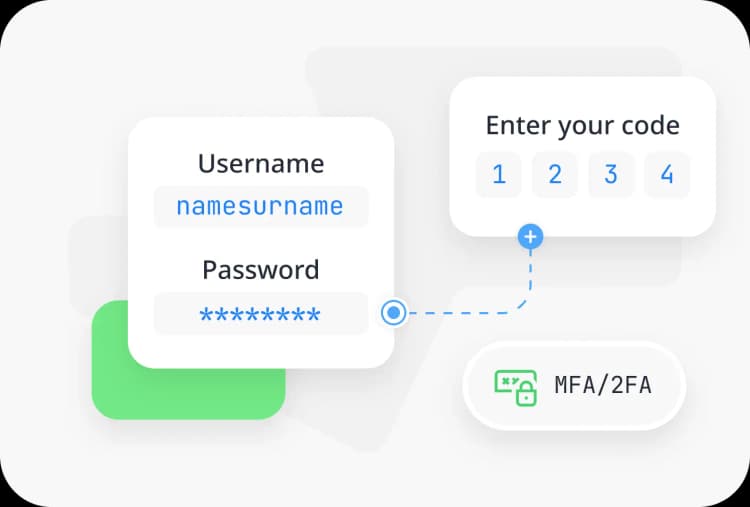
Two-factor SMS authentication combines something the user knows (typically a password) with something they possess (their mobile device, confirmed via OTP delivery). This structure is the essence of 2FA: neither factor alone is sufficient to authenticate, so a compromised password does not immediately result in a compromised account.
SMS 2FA in Practice
When SMS 2FA is enabled, the login flow works as follows:
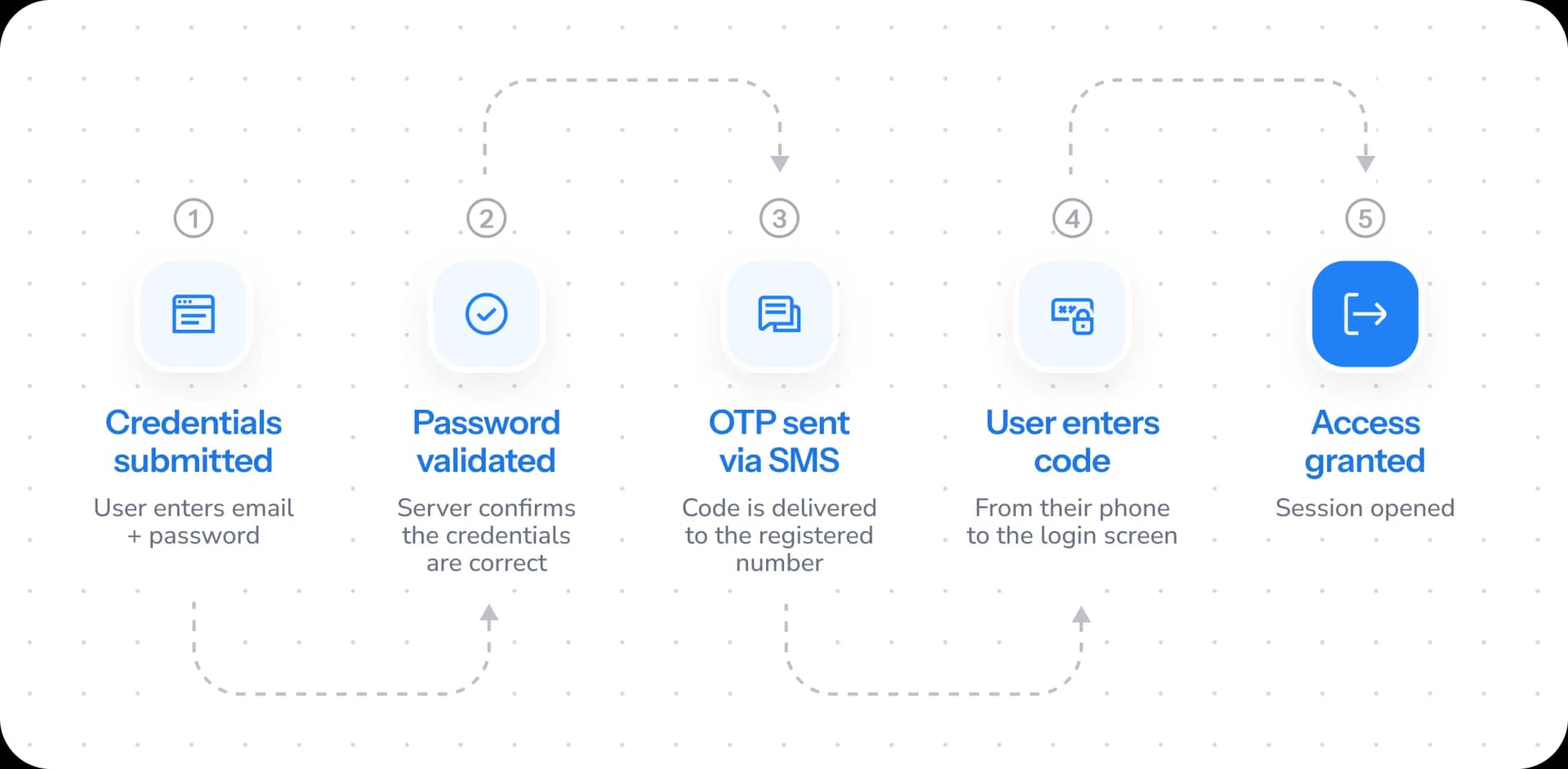
Password leaked or phished? The attacker still cannot proceed—without physical access to the user's phone, the OTP is unreachable.
Two-factor SMS authentication is the most common form of 2FA deployed at scale across consumer applications—largely because it requires no additional app, no hardware token, and no user education beyond "check your messages."
Where SMS 2FA Fits in MFA Frameworks
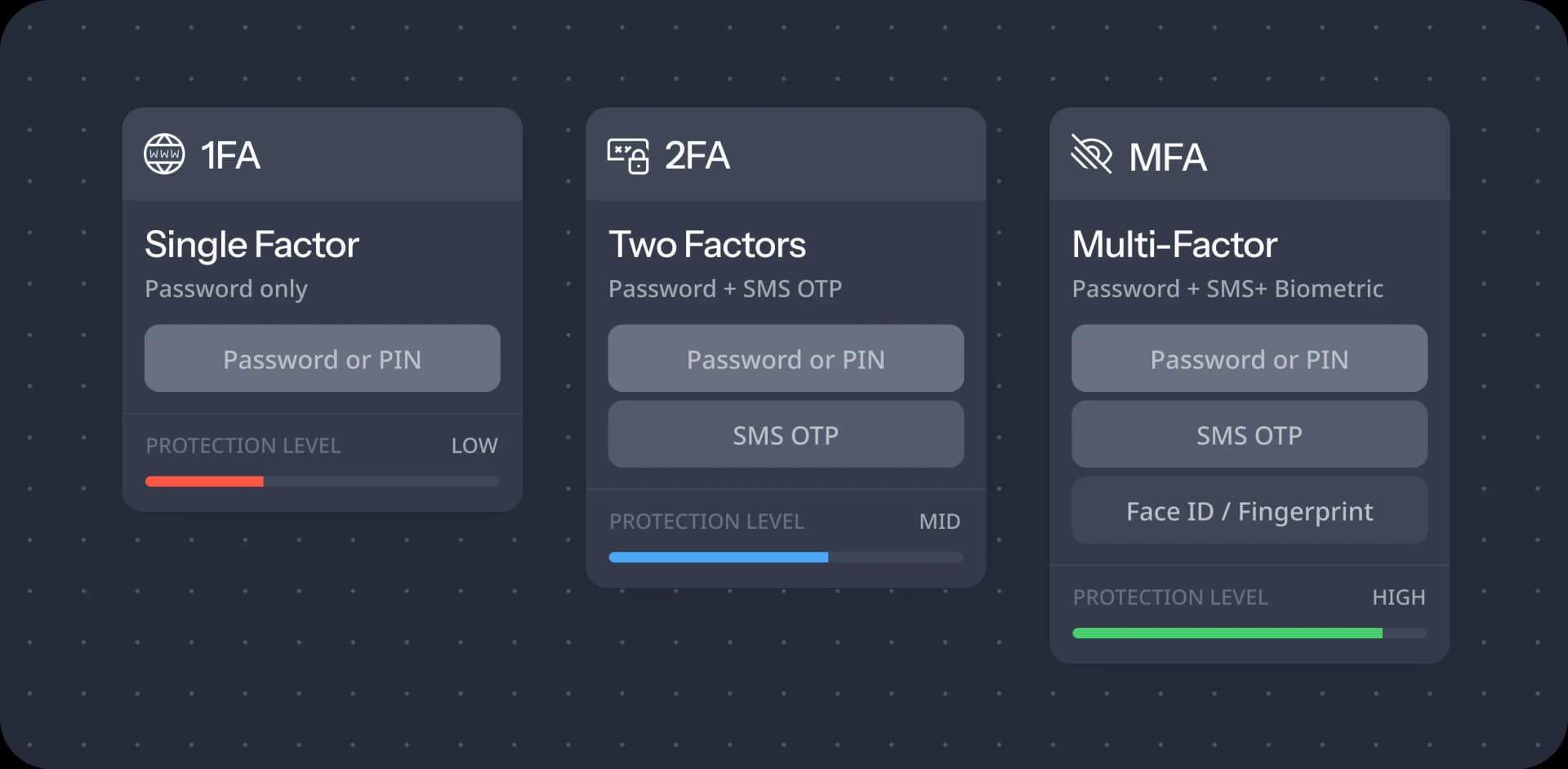
Multi-factor authentication extends the two-factor model to include three or more verification layers. In MFA frameworks, factors are typically categorized as: something you know (password, PIN), something you have (phone, hardware key), and something you are (fingerprint, face ID).
SMS authentication occupies the "something you have" category. It can be layered alongside biometric authentication (which covers "something you are") and a PIN (which covers "something you know") in high-security contexts such as banking or enterprise access control.
Regulatory frameworks increasingly require multi-factor authentication for specific use cases. The EU's PSD2 directive mandates strong customer authentication (SCA) for online payment transactions, requiring at least two independent factors from the three categories listed below. SMS OTP satisfies one of those factors.
Want to see how LANCK enables SMS OTP delivery with real-time fraud protection?
Explore the platform.
SMS Authentication API: How Developers Integrate It
An SMS authentication API is the technical interface that connects an application's backend to the messaging infrastructure responsible for generating and delivering OTPs. Developers send an API request specifying the recipient's phone number, and the service handles everything downstream: code generation, carrier routing, delivery confirmation, and expiry management.
What a Typical SMS Authentication API Call Looks Like
Most modern authentication APIs expose a RESTful endpoint—a web URL that allows systems to communicate using standard HTTP requests. A basic verification request involves sending a special type of request used to submit data to a server—POST request—to the provider's endpoint with the target phone number, message template, and any session-level parameters such as code length or expiry time. The response returns a session or request ID that the application uses to validate the user's entry on the backend.
The verification step is a second API call: the application sends the session ID along with the code the user entered, and the provider returns a confirmation indicating whether the code matches and is within its validity window.
What to Look for in an SMS Authentication System
Not all authentication SMS providers are equal. The key differentiators include: delivery latency on direct carrier routes versus grey routes, support for fallback logic (such as voice OTP or messaging app delivery if SMS fails), real-time delivery receipts, geographic coverage, and built-in fraud detection to identify artificial inflation of traffic.
LANCK authentication provides an API that handles all of these layers—delivering OTPs over SMS, voice, WhatsApp, and other channels via a single integration point, with cascade fallback and AI-powered traffic monitoring built in. The API is designed to integrate in minutes.
OTP SMS API and OTP Delivery Services
An OTP SMS API is specifically designed for the one-time password use case, as distinct from general messaging APIs that support a wide range of SMS content. OTP-specific services typically include automatic code generation, secure storage with expiry enforcement, rate limiting for code requests and validation attempts, and per-message delivery reporting.
What an OTP Delivery Service Handles for You
Building OTP delivery in-house involves more than it initially appears. Beyond the basic send-and-verify loop, a strong OTP delivery service manages carrier relationships, handles fallback when primary channels fail, applies fraud filters to prevent SMS pumping and other forms of traffic, and provides dashboards to monitor delivery rates, failure reasons, and latency by country and operator.
For most product teams, relying on a managed OTP delivery service is more practical than maintaining these integrations internally. It also shifts the burden of carrier-level compliance and anti-fraud monitoring to the provider.
SMS pumping—where attackers trigger large volumes of OTP requests to numbers, provided by rogue carriers, generating revenue through them—is a real cost driver in unprotected setups. Digital services that analyze request patterns and behavioral signals can detect and block this before it reaches the billing layer.
SMS Authentication Use Cases by Industry
SMS authentication is used across virtually every sector that handles user accounts, transactions, or sensitive data. Implementation details vary, but the underlying need—confirming that a real person controls the registered mobile number—remains consistent.
 Fintech and Banking
Financial services represent one of the highest-stakes environments for SMS user verification.
Banks and neobanks use SMS OTPs during onboarding (to confirm the phone number as part of KYC), during login (as a second factor), and at the transaction level (to authorize payments above a threshold). Regulatory frameworks, including PSD2 in the EU, mandate strong customer authentication for payment transactions, making SMS 2FA a compliance requirement rather than just a product choice.
For a detailed breakdown of authentication methods across fintech and banking segments, including how cascade delivery improves onboarding conversion rates, see LANCK’s guide to fintech and banking authentication.
 Online Gambling and Gaming Platforms
Gaming operators and gambling platforms use SMS authentication for age verification, account registration, and deposit confirmation. Regulatory requirements in licensed jurisdictions—including EU Anti-Money Laundering Directives and FATF recommendations—frequently mandate identity verification at the point of registration, with SMS acting as a fast, frictionless first-line check before deeper KYC steps.
Multi-factor authentication also protects player accounts from takeover attempts—a significant fraud vector in gaming environments.
For more on authentication in regulated gambling environments, LANCK’s guide to authentication in gambling covers the full picture.
 E-Commerce and Retail
Retailers integrate SMS authentication at checkout (for SCA compliance in applicable markets), during account recovery flows, and for high-value order confirmation. SMS OTP is also used to verify phone numbers at the point of account creation, reducing fake account registrations and improving the quality of customer data.
The low-friction nature of SMS makes it particularly suited to mobile commerce environments, where minimizing checkout steps is a conversion priority.
 Healthcare and Telemedicine
Patient identity verification is a core requirement in healthcare platforms dealing with sensitive records or prescription data. SMS authentication provides a practical way to confirm patient identity before granting access to health information, without requiring patients to install additional software.
In telemedicine, SMS OTP is commonly used for appointment confirmation and session access—ensuring the person joining the consultation is the registered patient.
 SaaS and Enterprise Platforms
Business software platforms use SMS 2FA to protect administrator accounts, privileged access, and sensitive data exports. Enterprise deployments often combine SMS OTP with role-based access controls and step-up authentication—requiring a fresh OTP for actions above a defined sensitivity threshold.
For user authentication flows and best practices in SaaS and enterprise contexts, LANCK’s guide to user authentication provides a structured reference.
 Ride-Hailing and On-Demand Services
Apps that connect service providers with consumers—transportation platforms, delivery services, and gig economy applications—use SMS verification at driver and rider onboarding to confirm phone number ownership. This links an account to a real, reachable mobile identity, improving accountability and reducing fraudulent or disposable registrations.

See how LANCK handles communication
across every step of the user journey
Limitations and Security Considerations
SMS authentication is widely deployed, but it comes with a set of limitations that security teams should understand in order to position it correctly within a broader authentication architecture.

A SIM-swap attack occurs when a fraudster convinces a mobile carrier to transfer a victim's phone number to a SIM card under the attacker's control.
Once the swap is complete, the phone loses service, and the fraudster receives the user’s calls and texts. This allows them to bypass SMS-based security, access bank accounts, and reset passwords for email or social media.

SS7 is the signaling protocol that underpins much of the global telecom network.
SS7 weaknesses allow SMS messages to be intercepted by parties with carrier-level infrastructure access. In practice, attacks are rare and targeted—but when they hit, the result is full account compromise: unauthorized transactions, data exposure, and potential regulatory liability under GDPR or PSD2. The mitigation is layering authentication signals.
Real-time phishing attacks—where an attacker tricks a user into entering their OTP on a fake site that immediately relays it to the legitimate platform—can circumvent SMS 2FA. These attacks don't break the cryptographic security of the OTP itself; they exploit user behavior. Mitigations include FIDO2-based authentication (which binds credentials to the legitimate domain) and user education around suspicious login prompts.

SMS pumping (AIT fraud) is a financial attack rather than a user-targeting one. Fraudsters trigger automated OTP requests to premium-rate or high-payout numbers they control, generating revenue from the volume of messages sent while a digital service absorbs the cost. Detection relies on monitoring request velocity, behavioral patterns, and the geographic distribution of verification attempts. An OTP delivery service with built-in fraud detection—such as the one offered through LANCK's authentication platform—can identify and block these patterns before they escalate.
Future of SMS Authentication
SMS authentication’s role is narrowing in some contexts and expanding in others.
Passkeys (FIDO2) are gaining real adoption—Apple, Google, and Microsoft have all committed to supporting them—and they eliminate the phishing and SIM-swap vectors that affect SMS OTP. The catch? They require device support and introduce account recovery complexity. SMS OTP remains the practical fallback for users who can't use passkeys and for markets with lower smartphone penetration.
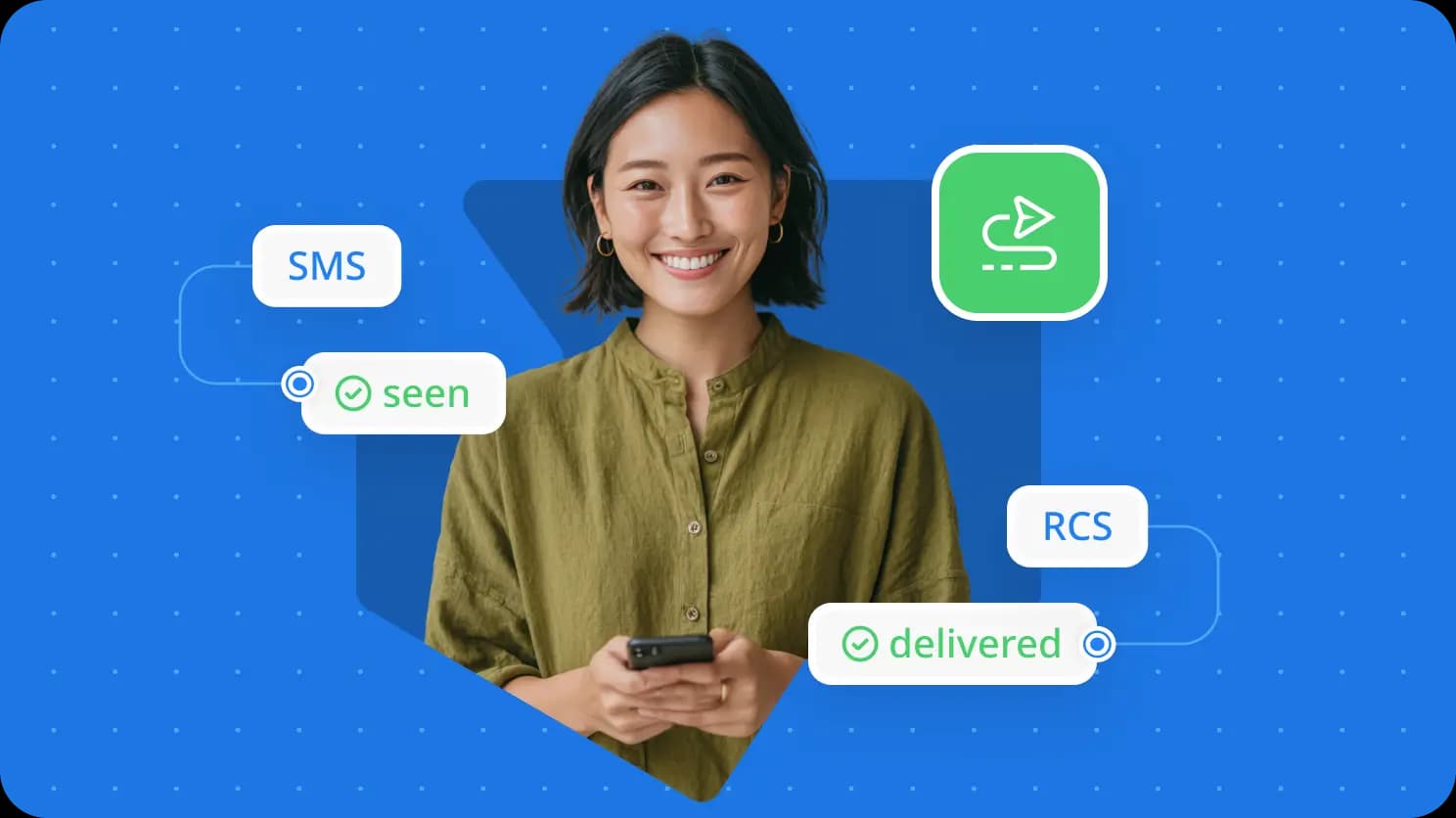
RCS is the carrier-native upgrade to SMS, adding verified sender branding, read receipts, and richer formats without requiring a third-party app. As coverage expands—accelerated by Apple's rollout—it will gradually replace standard SMS for some authentication flows. LANCK supports RCS and is available via omnichannel delivery alongside SMS, voice, messaging apps, and email.
AI-driven fraud detection is becoming table stakes rather than a premium feature. SMS pumping and AIT fraud are growing more sophisticated, and services that analyse timing patterns, device fingerprints, geographic anomalies, and carrier signals at the request level can block abuse before it generates cost.
Other Authentication Channels: How SMS Compares
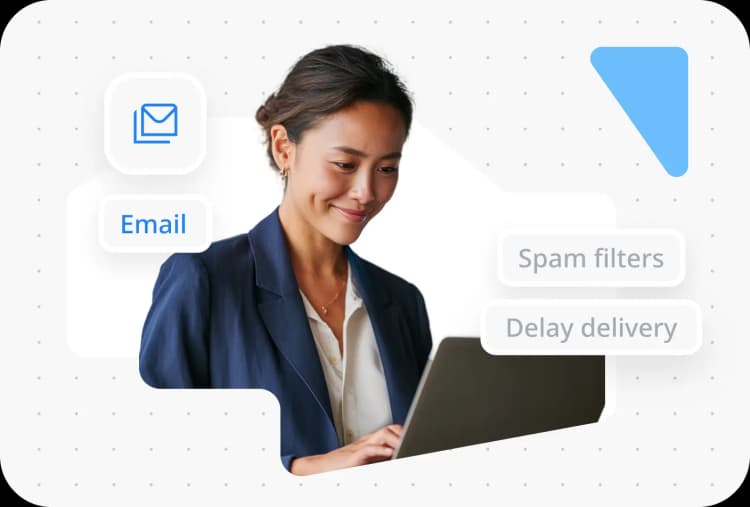
Email Authentication vs SMS Authentication
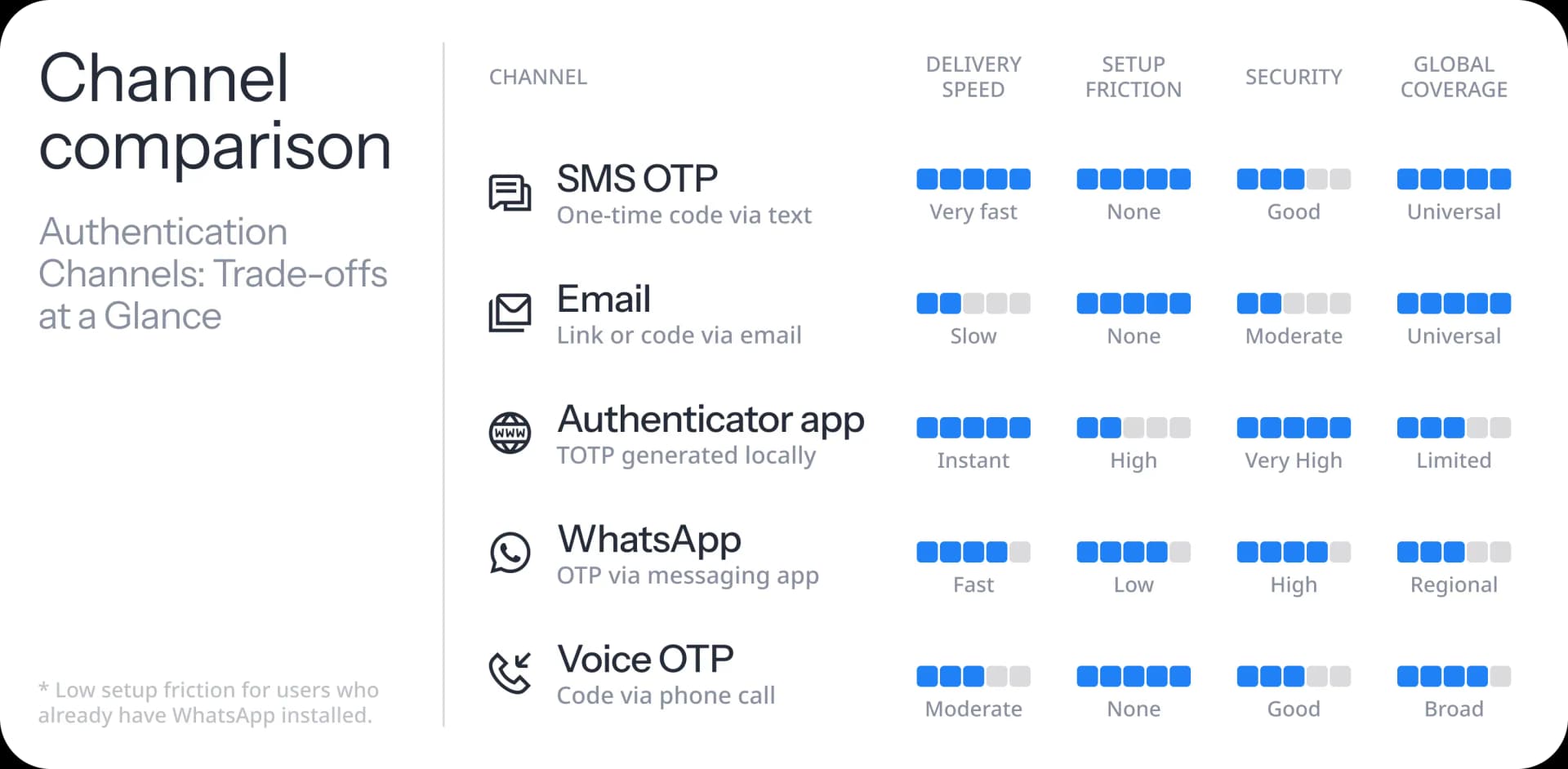
Email works well for low-urgency flows—account activation, password resets, and compliance documents—but falls short as a real-time factor. Spam filters can delay delivery, and email accounts are a frequent phishing target. For login and transaction verification, SMS is faster and more reliable. The two channels are complementary, not interchangeable.
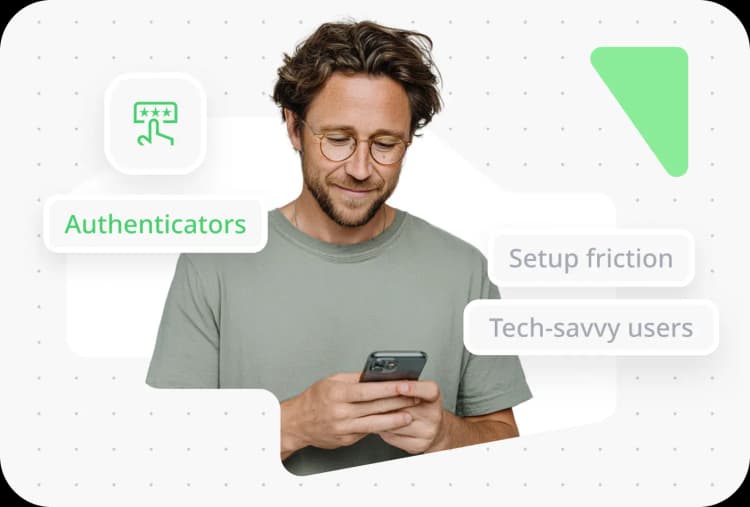
SMS vs Authenticator Apps
App-based authenticators (Google Authenticator, Microsoft Authenticator) generate TOTP codes locally, removing carrier dependency and interception risk entirely. The trade-off is setup friction—app installation, QR enrollment, and device-change recovery. They suit tech-savvy or enterprise users; SMS suits everyone else.
SMS vs WhatsApp and Other Messaging Apps
WhatsApp and messaging apps outperform SMS on delivery rate and user trust in high-penetration markets like Brazil, India, and Southeast Asia, because messages arrive within a verified business thread. The limitation is app dependency—users without the app can't be reached. Messaging channels work best as the first step in a cascade, with SMS or voice covering the remainder.
SMS vs Voice OTP
Voice OTP is the natural fallback when SMS fails—useful in markets with inconsistent carrier quality, for feature phone users, or for older demographics. Flash calls (where the user enters the last digits of an incoming number) are even faster and cheaper. LANCK supports these modes within a single integration, allowing teams to configure channel priority and cascade sequences by region and user segment.
Conclusion
SMS authentication has been a cornerstone of digital user verification for over a decade, and its position hasn't fundamentally changed—what's changed is the context around it. Emerging alternatives like passkeys are real and gaining momentum, but they're additive to the authentication landscape rather than immediate replacements, particularly for the global consumer base that SMS already serves reliably.
The practical question for most product and engineering teams isn't whether to use SMS authentication, but how to implement it effectively: with appropriate fallback logic, fraud detection, real-time delivery monitoring, and a channel strategy that serves users across different geographies and device capabilities.
For teams that need a production-ready foundation, LANCK authentication covers the full stack—SMS OTP delivery, cascade routing across voice, messaging, email, and RCS channels, AI-driven fraud protection, and API integration designed for rapid deployment.
FAQ
What is SMS authentication?
SMS authentication is the process of verifying a user's identity by sending a time-limited one-time code to their registered mobile phone number. The user enters the code to confirm they control the number associated with their account. It's used in login flows, onboarding, account recovery, and transaction authorization across digital services.
How does SMS 2FA work?
Two-factor SMS authentication adds a second verification layer on top of a password. After a user enters their credentials, the system sends an OTP to their phone number. The user must enter that code to complete login. Even if a password is compromised, the attacker can't access the account without also controlling the user's phone.
Is SMS OTP secure?
It is significantly more secure than a password alone. Its known vulnerabilities—SIM-swap and SS7 interception—require either carrier social engineering or access to telecom infrastructure, placing them outside most everyday threat models. For high-value accounts, layering SMS OTP with passkeys or biometrics adds meaningful protection.
What is an SMS authentication API?
A programmatic interface that allows applications to send OTPs and verify user-entered codes without managing carrier integrations directly. Developers send a request with the recipient's phone number; the API handles code generation, delivery, and validation via two RESTful endpoints.
What is an OTP delivery service?
A managed platform that handles the full OTP lifecycle—generation, routing, delivery confirmation, fraud detection, fallback logic, and analytics. It offloads carrier-level complexity from in-house engineering teams.
What is SMS identity verification?
The use of a text message OTP to confirm a user controls the mobile number on their account. It is possession-based verification—confirming phone ownership, not full identity. In KYC contexts, it's typically combined with document verification and biometrics.
What is MFA and where does SMS fit?
Multi-factor authentication requires two or more independent factors: something you know (password), something you have (phone), something you are (biometric). SMS OTP covers the "something you have" factor and can combine with a password and biometric for a three-factor flow.
What is the difference between SMS OTP and TOTP?
SMS OTP is generated on demand and delivered via text. TOTP (used by authenticator apps) is generated locally on the device every 30 seconds, with no network request. TOTP eliminates interception risk but requires app installation and enrollment. SMS OTP is simpler but depends on carrier delivery.
How do I prevent SMS pumping fraud?
Layer rate limiting per IP and phone number, apply geographic anomaly detection, use CAPTCHA on high-volume triggers, and rely on provider-level fraud detection. LANCK’s authentication platform applies AI-based filtering across all outgoing OTP traffic without requiring custom implementation.
Can SMS authentication work alongside passkeys or biometrics?
Yes. Passkeys handle the primary path on supported devices; SMS OTP covers fallback for account recovery and unsupported digital services. SMS can also be combined with biometrics in step-up flows—biometrics for routine login, OTP for high-risk actions.