User Authentication Methods and Channels for Different Industries

Blog
Digital services operate in an environment where identity is constantly targeted. Account takeover, phishing, automated fraud, and credential leaks have made weak access controls a major source of security incidents, with breaches now costing organizations an average of over $4.4 million.
Authentication determines who can access systems, approve transactions, and perform sensitive actions—but strength alone isn’t enough. Verification must reach the legitimate user quickly and reliably. If a one-time code or approval request doesn’t arrive, even a secure system becomes unusable.
Platforms like LANCK combine strong authentication methods with dependable, omnichannel delivery. They coordinate OTP and MFA through SMS, voice, messaging apps, and email, ensuring verification succeeds even when conditions vary.
This guide explains the key authentication methods, delivery channels, and orchestration strategies that enable reliable user verification across industries.
What Is User Authentication and Why It Matters
What is user authentication? It’s the process of confirming that a person (or system) attempting access is genuinely who they claim to be. Put simply, it answers: “Are you the real account owner?” Only once that check succeeds should a service allow access to sensitive data, transactions, or high-impact account actions.
Authentication is often mixed up with authorization, but they solve different problems:
- Authentication verifies identity (who you are).
- Authorization grants permissions (what you can do after identity is verified).
Example: Signing into an online banking app is authentication. Being able to transfer funds, update a phone number, or view statements is governed by authorization rules tied to that verified identity.
For businesses, weak authentication is not just a “login inconvenience.” It increases exposure to financial loss, fraud, and long-term trust damage. Financial services are consistently among the costliest industries for breaches, with average incident costs exceeding $5.5 million, reflecting direct monetary impact plus regulatory consequences.
Done well, user verification supports three outcomes that matter across industries:
- Trust: Users complete onboarding and approve actions because the flow feels secure and dependable.
- Compliance readiness: Regulated industries often require stronger checks for sensitive actions.
- Fraud prevention: Fewer takeovers, fewer abusive sign-ups, fewer costly escalations.
There’s one practical truth underneath all three: if the verification message doesn’t arrive, you don’t just lose a login—you lose conversion, confidence, and often the customer.
Platforms like LANCK address this by coordinating authentication across multiple channels from one system, alongside enterprise notification and marketing messaging capabilities to ensure critical communications reach users when they matter.
How Does Authentication Work: User Authentication Methods Explained
For enterprises, authentication is not just a security feature—it directly affects conversion rates, fraud exposure, regulatory compliance, support costs, and user experience. Different methods offer different trade-offs in strength, usability, implementation complexity, and delivery requirements. Understanding how authentication works in practice helps teams choose approaches that protect high-risk actions without creating friction that drives users away.
At a practical level, authentication follows a structured challenge-and-response pattern:
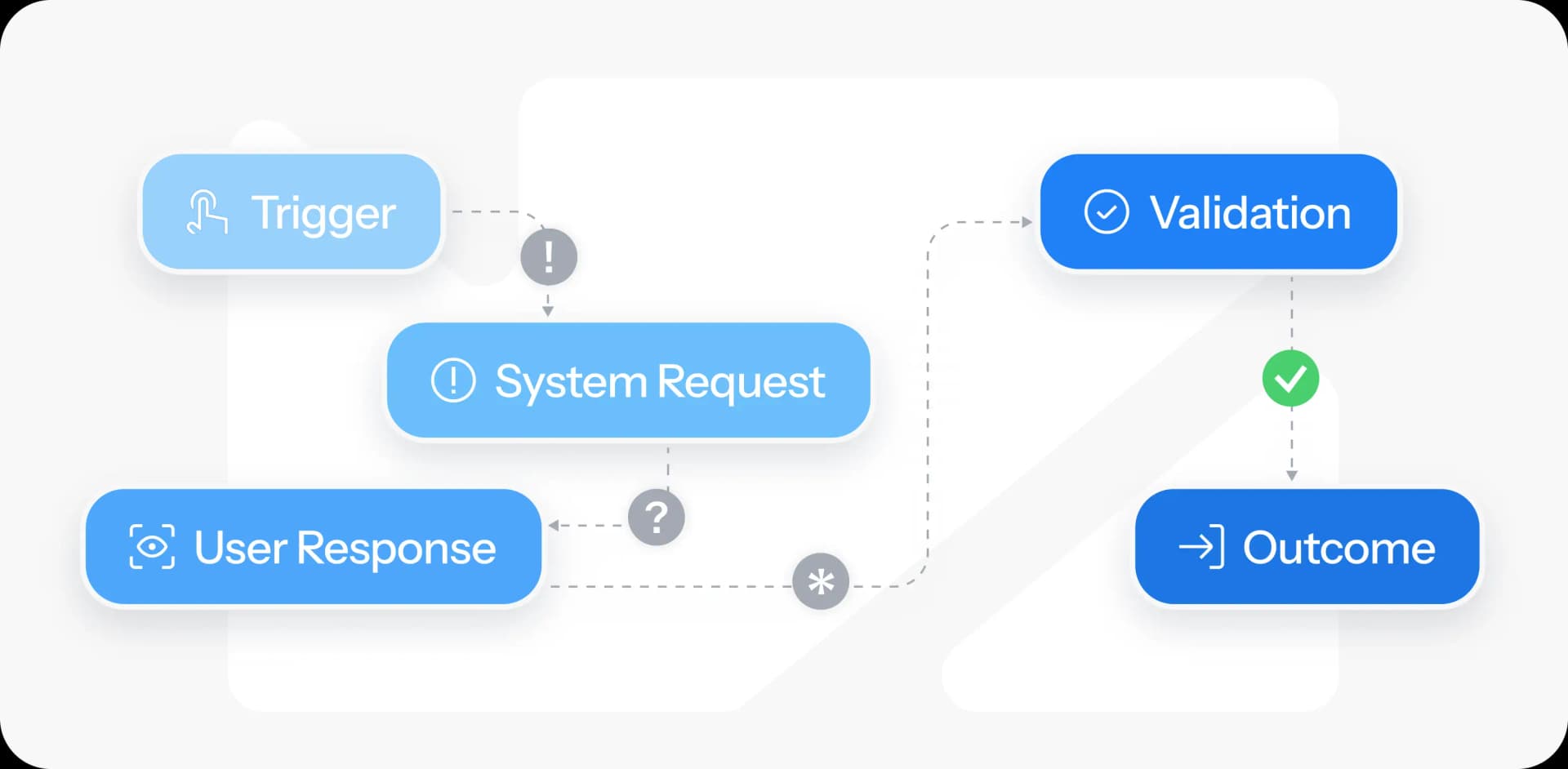
To go beyond generic definitions, it helps to separate authentication factors (what evidence is used) from methods (how that evidence is applied). This matters because a single factor can be delivered through different methods and channels.
Authentication Factors
Authentication factors represent the different types of proof used to confirm a user’s identity.
| Authentication Factor | Examples / Methods | Protection Level & Risks | Convenience |
|---|---|---|---|
| Something you know | Passwords, PINs, security answers | Low—vulnerable to phishing, reuse, and credential stuffing | Medium |
| Something you have | Mobile device receiving OTP, authenticator app, hardware security key, smart card | Medium to High—requires physical access to the device | Medium |
| Something you are | Biometrics such as fingerprint or facial recognition | High—difficult to counterfeit on-device | High |
| Behavioral / contextual factors | Device reputation, location anomalies, IP risk, access timing, usage patterns | High—detects suspicious activity (e.g., “impossible travel”) | Very High |
Major Authentication Methods
Common user authentication approaches used in real deployments include:
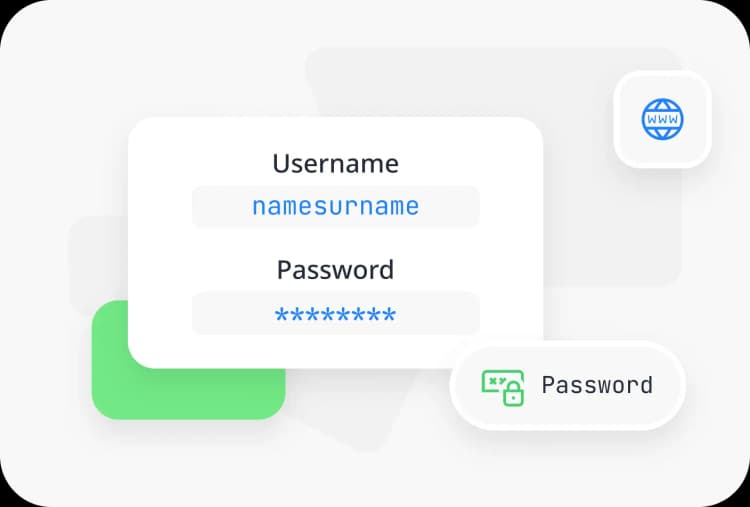
Password-based authentication
Username + password remains widespread, but it’s increasingly treated as the first step rather than the whole solution.
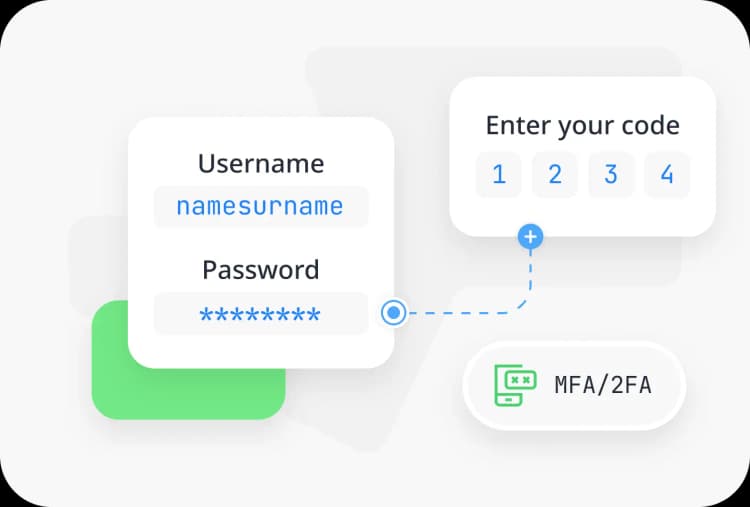
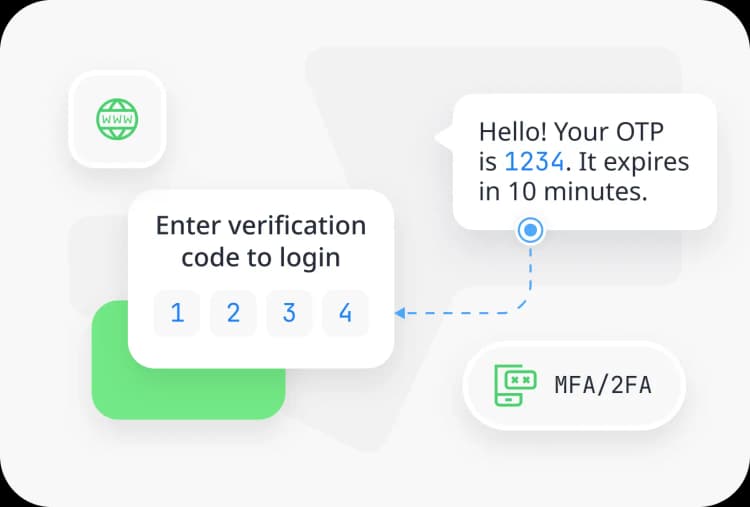
Multi-factor authentication (MFA / 2FA)
MFA requires two or more independent proofs of identity (e.g., password and a one-time code). Microsoft reports that MFA can prevent 99.9% of account compromise attacks.
One-time passwords (OTP)
Temporary codes used once per login or approval (often expiring quickly). OTP is common for 2FA and step-up flows because it reduces replay risk—but only if delivery is fast and consistent.
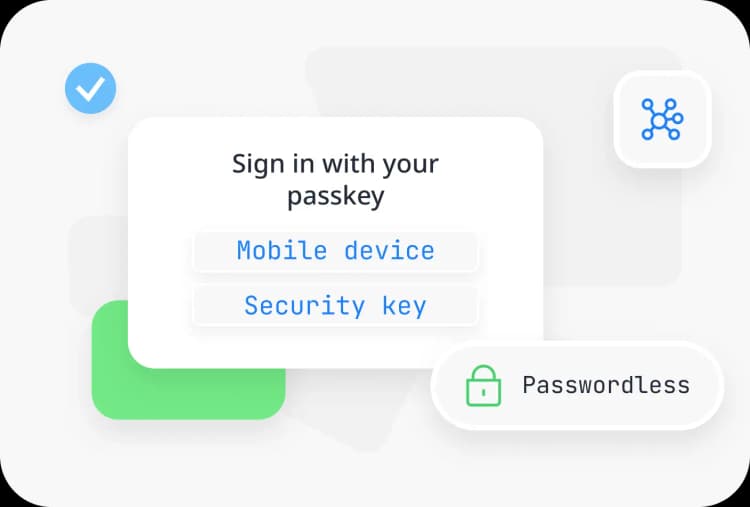
Passwordless authentication
Uses device-bound keys, secure links, or approval prompts to reduce phishing exposure and credential reuse. Over 15 billion online accounts now support passwordless authentication.
Biometric authentication
Often used to unlock a credential stored on the device (the biometric isn’t necessarily the credential itself). Strong implementations pair biometrics with device security and recovery paths.
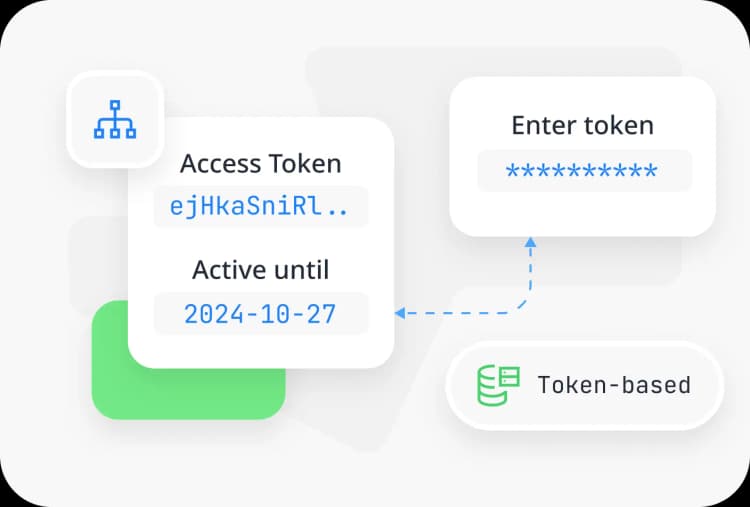
Token-based authentication
Either user-facing tokens (authenticator codes, hardware keys), or post-login session tokens for apps/APIs. Token design influences session lifetime, revocation, and resistance to abuse.
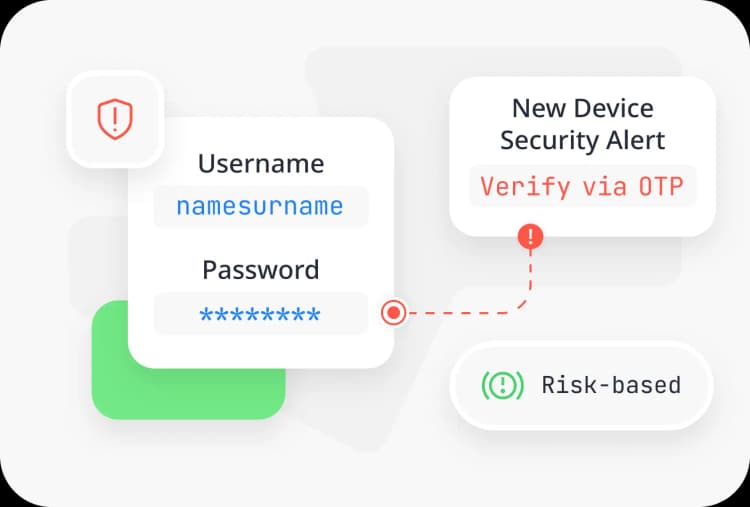
Risk-based / adaptive authentication
Raises verification requirements when signals look suspicious. Common triggers include new device, unusual location, “impossible travel,” or high-value actions (e.g., changing payment details).
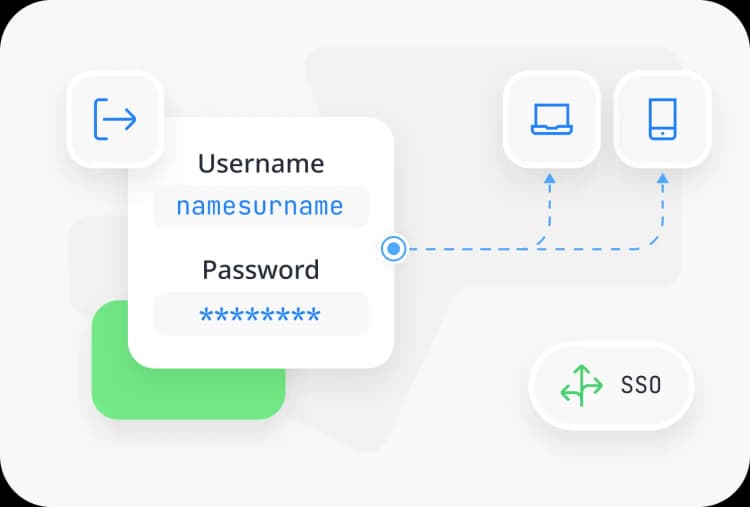
Single sign-on (SSO)
Allows users to authenticate once via an identity provider and access multiple services. Because access is centralized, initial authentication should be strong (typically MFA/2FA).
Example of Authentication in Practice
A familiar real-world scenario looks like this:
- A user signs in from a new phone.
- They enter a password (something they know).
- The system detects an unfamiliar device (context factor).
- The service sends an OTP (something they have) through SMS or a messaging app.
- For higher risk, the app requests biometric confirmation (something they are).
- Access is granted only when checks succeed.
In practice, authentication is not a single control but a layered system that must align with business risk, user expectations, and operational realities—and it only succeeds when both the security method and its delivery work reliably.
User Authentication Channels
For businesses, authentication channels are not interchangeable delivery options—they determine whether verification actually reaches the user in real conditions. Channel selection should reflect user behavior, device access, network reliability, regional constraints, and the urgency of the action being verified.
Authentication methods define how identity is proven, while channels determine how that proof reaches the user. This distinction is operationally critical: even strong methods fail when the code, link, or approval request does not arrive quickly and consistently. Platforms like LANCK coordinate delivery across channels from a single system, including automated fallback when one path is unavailable.
Below are the most common channels used in enterprise authentication programs.
SMS Authentication
SMS remains one of the most used channels for OTP and 2FA because it works on basic mobile networks and offers near-global reach. It’s especially useful for onboarding, transaction approval, and recovery when app installation or data access can’t be assumed. Large-scale verification programs often rely on enterprise SMS messaging for authentication and notifications to keep delivery consistent across carriers and regions.
Voice Authentication
Voice authentication helps when SMS delivery is blocked, delayed, or inaccessible. Automated calls can deliver spoken OTPs, while flash calls verify identity using the final digits of an incoming number without requiring the call to be answered. Voice OTP and flash calls are commonly used as fallback channels in high-reliability verification flows.
Messaging Authentication
Messaging apps deliver verification inside familiar chat interfaces, which can reduce confusion and improve engagement compared to unfamiliar sender IDs. They also support richer branded experiences and interactive flows.
LANCK supports major messaging ecosystems including:
Telegram alone surpassed 1 billion users in 2025, which is one reason messaging channels can be a practical verification surface in many regions.
Rich Communication Services (RCS) provides a similar rich messaging experience through the device’s native messaging app, without requiring users to install a separate application. This makes RCS a valuable option where supported by carriers and devices.
Email Authentication
Email is widely used for links and codes during sign-up, password resets, and recovery. It tends to be slower than mobile channels, but it’s a dependable secondary route that works across devices without requiring a phone number. Email authentication typically complements broader communication alongside communication and marketing.
Push Notification Authentication
Push authentication allows users to approve logins or sensitive actions directly from a trusted device. When a sign-in attempt happens, the user receives a notification and can confirm with a single tap rather than typing a code. Because approval occurs on a registered device already linked to the account, push can deliver strong security with minimal friction.
Multichannel Authentication vs Omnichannel Authentication
Providing several channels isn’t enough if they don’t work together—a failure in one can still stop the entire authentication flow.
Multichannel Authentication
Multichannel means several channels exist (SMS, voice, email, messaging apps), but they operate as separate options:
- The user chooses one
- If it fails, they retry or switch manually
- Channels do not share context
This increases reach, but it turns delivery failure into a user problem—exactly where drop-off occurs.
Omnichannel Authentication
Omnichannel authentication treats channels as one continuous verification journey:
- A single workflow across touchpoints
- Context persists across channels
- Routing adapts dynamically
- Failures can be handled automatically
LANCK supports coordinated verification across SMS, voice calls, WhatsApp Business, Telegram, Viber, RCS, and email from one platform. This unified channel coverage enables true omnichannel authentication.
Cascade Communication
Cascade communication optimizes both delivery success and cost by intelligently routing messages across multiple channels.
What Cascade Communication Means in Practice
Cascade delivery uses a predefined sequence of channels that automatically switches when delivery is not confirmed within a set time window. The optimal order depends on factors such as region, user preferences, traffic volume, regulatory requirements, and network conditions. The example below illustrates a typical cascade scenario in which a primary channel fails and fallback routing ensures verification completion.
Example cascade flow:
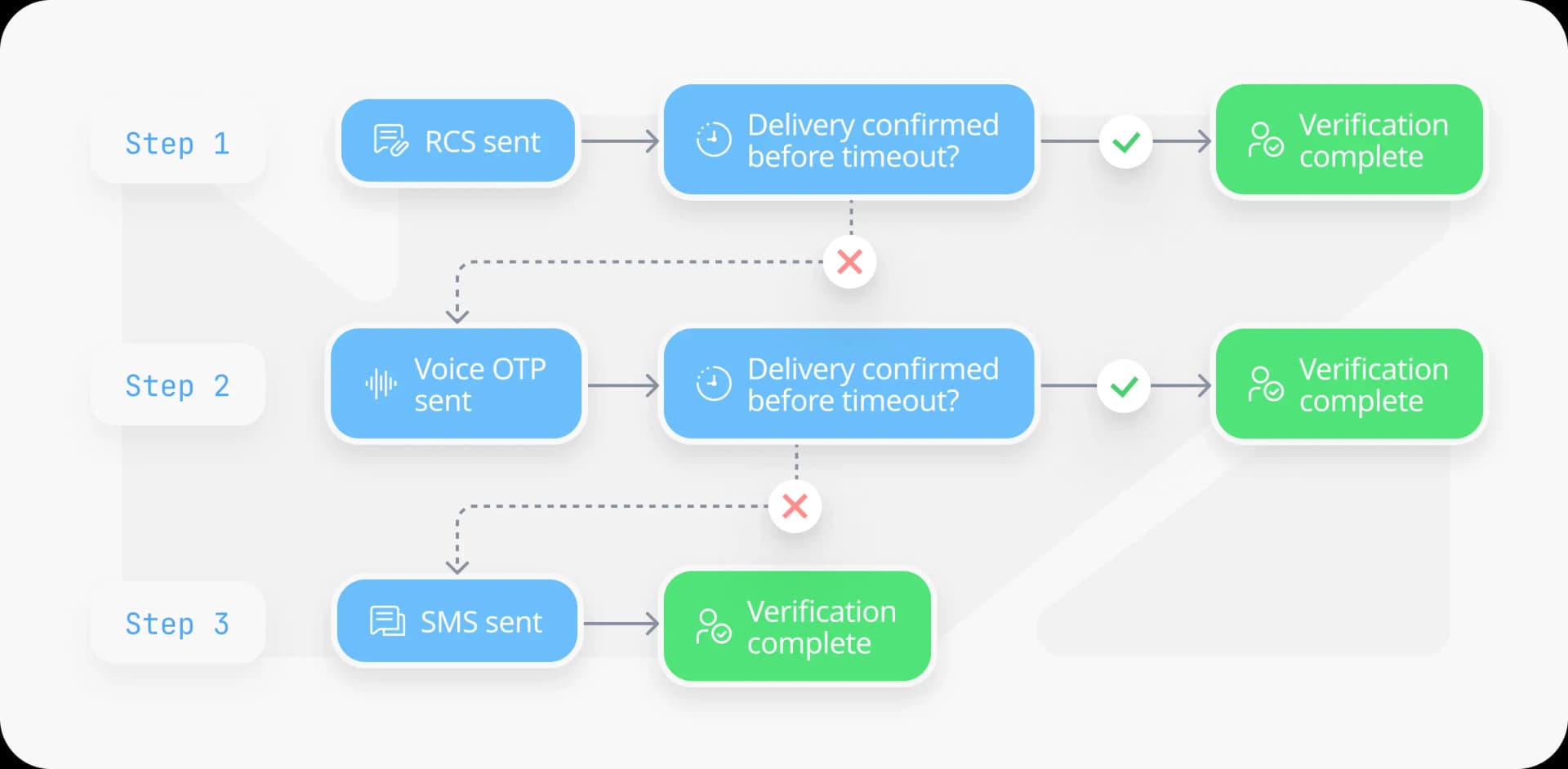
This approach provides:
- Automatic switching between channels
- Customizable delivery sequences
- Higher completion rates
- Cost optimization through smarter channel use
Proven Delivery Performance
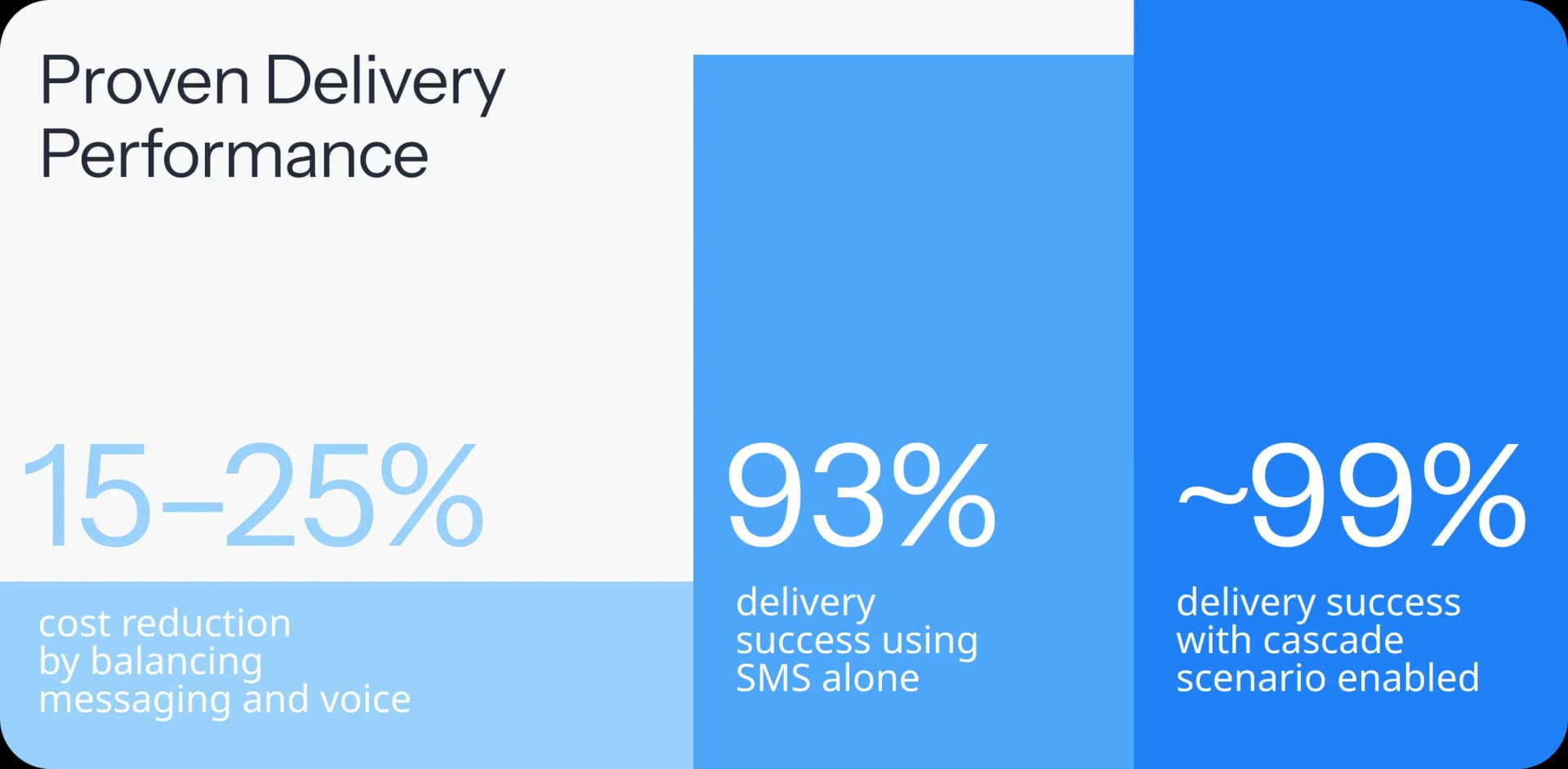
The impact is practical: fewer failed logins, fewer abandoned actions, and fewer support tickets.
When Cascade Routing Becomes Essential
In practice, single-channel delivery can fail due to:
- Network congestion or outages
- Regional restrictions
- Roaming inconsistencies
- Message filtering or blocking
- Device limitations
- Late OTP arrival
Cascade isn’t a “nice extra”—it’s what makes authentication dependable in real environments, not only ideal ones, as demonstrated by LANCK authentication.
Authentication Strategies for Different Industries
Authentication requirements are shaped less by technology and more by operational risk. The goal is not only to prevent unauthorized access, but to ensure legitimate users can complete critical actions without disruption.

Financial & FinTech—Account Takeover and Transaction Fraud
- Immediate financial loss and regulatory exposure from unauthorized access
- Real-time payments and trading require minimal verification delay
- High-risk actions (transfers, payout changes, recovery) need strong controls
- Constant, sophisticated fraud attempts
Retail & E-Commerce—Conversion Loss and Chargebacks
- Checkout friction increases cart abandonment
- Weak verification enables fraud, refund abuse, and disputes
- High volumes magnify small failure rates into major losses
- Account recovery flows are common attack paths
Gaming & iGaming—Continuous Activity and Stored Value
- Accounts hold funds, assets, or winnings
- Frequent multi-device logins
- Verification delays disrupt gameplay and retention
- Fraud includes takeover, bonus abuse, and payment manipulation
Transportation & Logistics—Operational Disruption
- Protects workforce systems, not consumer accounts
- Failures delay dispatch, routing, and confirmations
- Distributed staff across locations and networks
Travel & Hospitality—Time-Critical Access
- Global users across networks and roaming conditions
- Authentication during urgent moments (check-in, booking changes)
- Unreliable connectivity while traveling
- Failure can block access to essential services
Across these environments, security cannot be separated from usability. Effective authentication must resist abuse while ensuring legitimate users can complete essential actions without delay.
Choosing the Right Authentication Approach
To ensure the right authentication approach, you should:
- Balance security, delivery reliability, cost, and user experience. High-risk actions require stronger verification, while everyday interactions need to stay fast and low-friction.
- Ensure authentication works in real-world conditions. If a code or approval request doesn’t arrive, even a secure flow fails.
That’s why enterprise authentication should be evaluated not only by method, but by channel performance, fallback options, and the ability to maintain verification across changing user conditions.
Channel Trade-Offs: Cost vs Conversion
| Channel | Cost Level | Delivery Reliability | Conversion Impact |
|---|---|---|---|
| SMS | Highest | Very High (global reach) | High |
| Voice (OTP / flash call) | High | Very High | High |
| WhatsApp Business | Medium | High (internet-based) | High |
| RCS | Medium | High (device/carrier dependent) | High |
| Telegram | Low–Medium | High (internet-based) | High |
| Viber | Low–Medium | High (internet-based) | High |
| Lowest | Medium | Medium |
Optimizing only for cost reduces delivery success. Optimizing only for UX increases spend. Effective authentication balances both through intelligent channel orchestration and fallback.
Where Single-Channel Authentication Fails
In real-world conditions, delivery failure is common:
- In-flight users → No cellular SMS, but internet-based channels may still work
- Roaming users → SMS delays, failures, or restrictions
- Carrier filtering → Messages blocked before reaching the user
- No internet access → Messaging apps unavailable, fallback to SMS/voice required
- Device loss or change → App-based or push authentication fails
Without fallback, these scenarios lead directly to verification failure, user drop-off, and revenue loss.
Why Enterprises Choose LANCK
LANCK provides an enterprise authentication platform built for these realities—combining security, delivery performance, and operational efficiency in a single system.
Key capabilities include:
- Global reach: OTP delivery to 190+ countries
- Omnichannel verification: SMS, voice, WhatsApp Business, RCS, Telegram, Viber, and email
- High reliability: 99.99% monthly API uptime and up to 2,000 TPS throughput
- Cascade routing: Automatic channel switching to maximize delivery success and reduce costs
- Analytics: Real-time performance insights and reporting
- Easy integration: OMNIAPI plus compatibility with major CRM systems
- Fraud protection: AI-driven detection of suspicious traffic and abuse
Together, these capabilities ensure verification succeeds even when networks are unstable, users are roaming, or device conditions vary.
For a broader perspective beyond authentication itself, including notification and marketing, see our article on enterprise communication use cases for improving customer experience.
Ensure Reliable, End-to-End Authentication with LANCK
User authentication has moved beyond being a basic login safeguard. It now plays a strategic role in fraud prevention, compliance readiness, operational security, and customer trust. To shift from theoretical security to real-world reliability, organizations need a layered approach.
The strongest programs connect three layers:
- Methods: How identity is proven (OTP, biometrics, MFA).
- Channels: How verification reaches the user (SMS, voice, messaging apps).
- Orchestration: How reliability is maintained through coordination and automated fallback.
Omnichannel authentication supported by cascade communication helps ensure verification succeeds when it matters most. With automatic channel switching, organizations can reach ~99% delivery success and reduce costs by 15–25% compared to single-channel approaches.
For authentication that remains reliable at scale, start with a unified delivery platform designed for performance and efficiency.